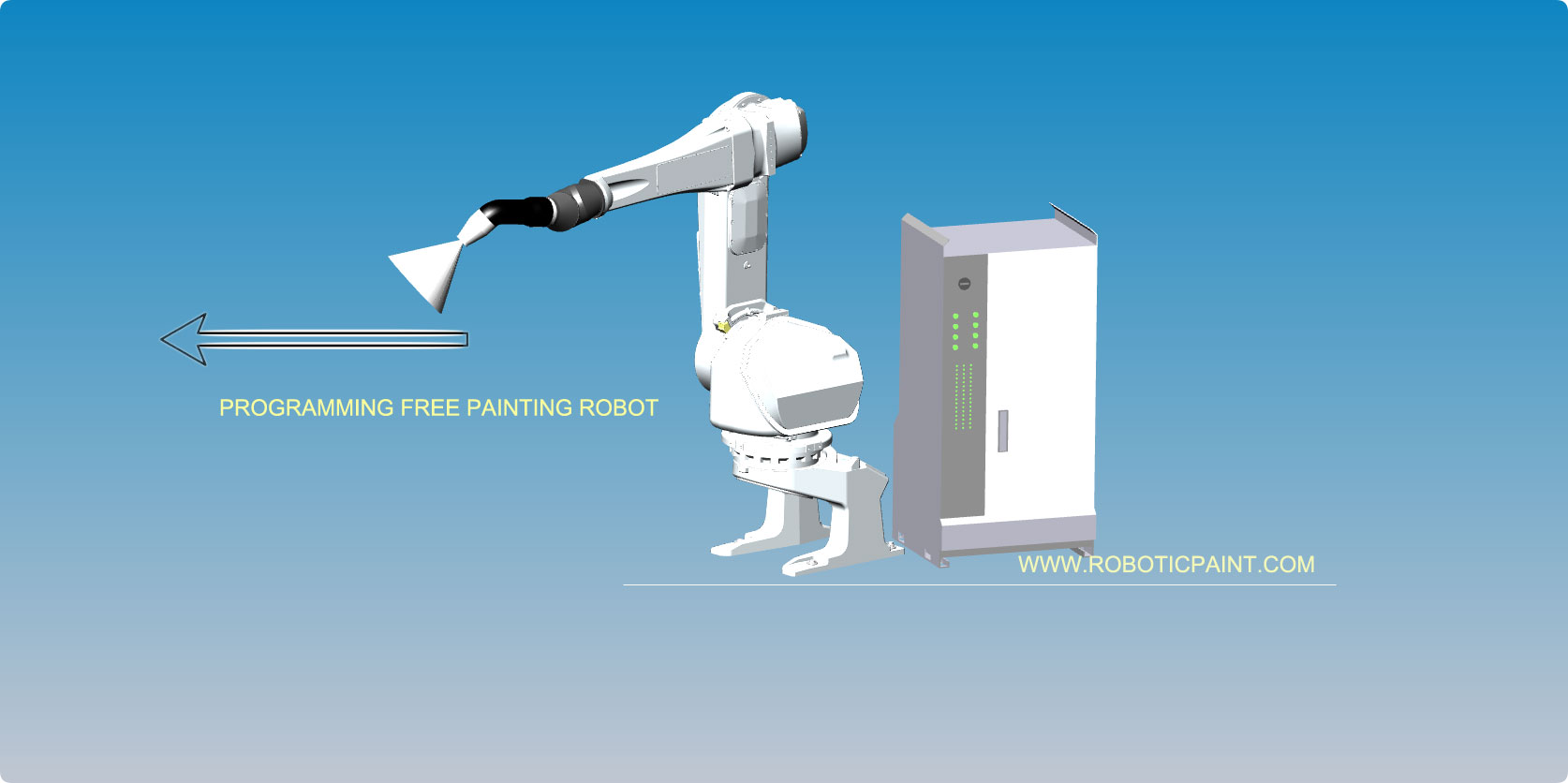
Painting via armed robot is no longer a challenging job due to fast technology development. Either the available solutions or the costs are quite friendly comparing to a decade before. Besides the basic mechanical movement on robot arm, we can simulate the process directly via spray gun and completely programming free!
This robot features both handheld drag teaching and point-to-point programming. For handheld drag teaching, the operator commands the desired spray trajectory, and the computer control system stores and outputs the relevant movements. The programming system allows for rapid creation and control of various spray programs during handheld drag teaching.
For the point-to-point system, programming includes both testing and execution. Pre-configured software allows the generation of critical points on a surface for spraying. Key points and operating parameters can be adjusted at any time. Storage management programming primarily utilizes a laptop computer integrated control system, issuing commands via digital codes to a back-up unit. Manual selection is then accomplished via a standard keyboard, a high-speed reporting system, or remote control.
Hardware System Configuration
The industrial computer is equipped with an Intel Atom N270 1.6 GHz processor.
Based on Windows platform, the industrial computer provides UI management, robot trajectory calculation, and PLC logic, enabling real-time operation through subsystems.
Position and velocity control of each robot axis is digitally driven by an internal DSP, capable of increasing axis quotas every 400 microseconds.
The user interface is displayed on a mobile panel equipped with an Intel PXA270 416 MHz processor and the Windows CE operating system.
Remote Desktop technology is used for communication via Ethernet.
The computer is equipped with a high-quality flash memory card for data storage. The flash card memory is user-configurable. Program backup is performed using a USB port.
Dual Teach Pendant Functionality
This programmer features a 6.5-inch TFT color display (touchscreen) with a resolution of 640×480 pixels and a three-way “dead man” safety feature: one for point-to-point programming and the other for emergency stop and key-off touchscreen functionality.
For programming, the display can be used as a keyboard, allowed for three-dimensional simulation. The mobile operating panel comes with a 10-meter cable (located near the robot).
Software Configuration
- Self-learning programming by moving the robot wrist with the joystick.
- Point-to-point programming with a mobile operating panel.
- Acceleration and deceleration during program execution for self-learning and point-to-point programming.
- Self-learning and point-to-point programming for fixed parts with online tracking of movement.
- Test function for point-to-point programming with forward and reverse commands to control recorded points.
- Automatic spray gun cleaning routine.
- Interface for connecting to a terminal via Ethernet communication.
- Display of error indication alarms and daily error log.
- Production report: Start date and time, end date and time, number of parts, and number of parts sprayed (by default).
Program Modification Features
- 1-200% speed adjustment
- Adjustable spray distance
- Optional robot Cartesian coordinate system (XYZ)
- Automatic control of atomizing and shaping air (optional)
- Automatic color change (optional)
External Connections
- I/O connection via remote PLC
- Ethernet connection for terminal devices
- Ethernet connection for program backup
- Remote network assistance (optional)
Real-time Self-Learning (Teaching)
This system allows direct programming of objects. The operator can spray objects in real time using a joystick on the robot arm/wrist and connected to the control panel. A significant advantage is that by observing the final coating result, the operator can modify or adjust the spray cycle in real time.
The joystick allows for operations such as starting/stopping programs, saving programs, turning the spray gun on/off, controlling the rotary table, and model dependency, allowing a single operator to program the robot.
Programming time must be consistent with the spray cycle. The operation speed can be adjusted according to actual needs after entering automatic mode, thereby reducing spraying operation time.
Advantages of Handheld Teaching Robots
- Fast Programming
- No prior experience required, allowing one person to perform multiple tasks;
- Easy to learn and understand, mastering the process in just one day;
- Support automatic programming while the workpiece is in motion;
- Repeatability and high precision, the production quality of workpieces can be controlled;
- Can be used with conventional spray guns and electrostatic spray guns by signal interlocking control;
- The robot does not require point-to-point teaching programming;
- Can be used with any paint, whether water-based or solvent-based, colored or clear, or powder;
- Within the robot’s working range, the workpiece can be of any shape, and the robot can simulate the path of manual spraying method;
- The program can be integrated into existing equipment with minimal modifications.
Robot System Components
Articulated Robot Control System Components:
B&R Mobile Panel, X20 System CPU Module Series, APC620 Industrial Computer, X20IO, and Servo Controllers communicate via real-time Ethernet POWERLINK.
Articulated Robot Control System Features
- A high-performance industrial computer serves as the main controller, with built-in Windows and real-time operating systems, ensuring an open and reliable system.
- Supports multi-channel robot interconnection for easy robot networking.
- Comprehensive hardware platform and support for third-party hardware products.
- Integrated unified software development platform reduces development time by 30%.
- Proven forward and inverse transformation library with support for user-defined algorithms.
- Fully configurable robot language and software interface.
- Torque feedforward algorithm effectively solves front-end arm vibration issues.
- Robot teaching function.
- Easily expandable axis count, such as positioners.