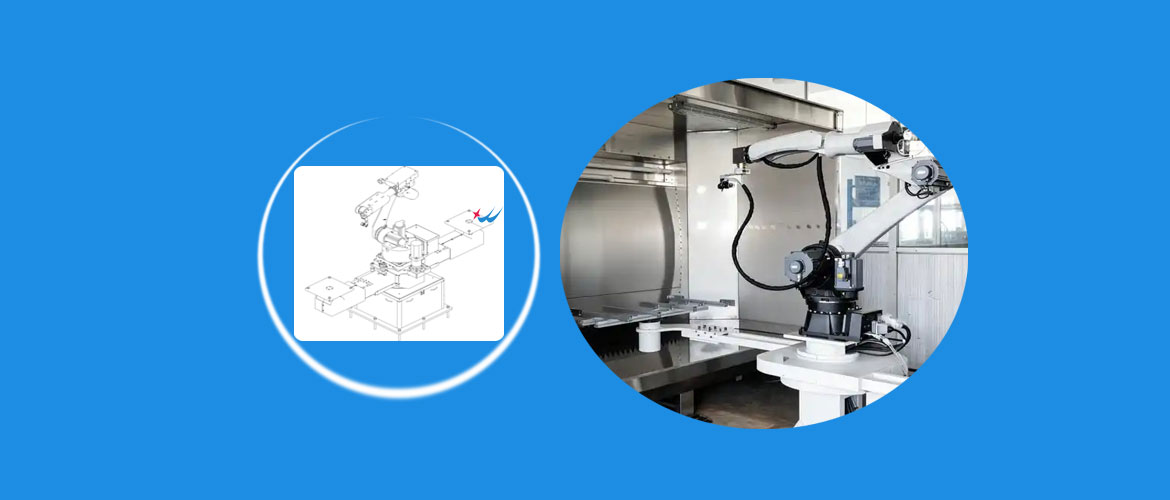
For our painting robot and painting machines, there’s always a turntable involved for product handling. Normally we use I and H type turntables, but sometimes we also use Y type design according to operation requirements. What would be the difference and why there’re such options?
The core differences between I/H and Y type turntables lie in their workpiece load layouts, whether material handling and spraying occur in parallel, and their suitability for specific production line cycle times. The I-shaped model operates serially at a single station; the H-shaped model uses a dual-station setup to alternate between spraying and loading, enabling continuous flow; and the Y-shaped model features multi-directional branching, making it suitable for collaborative robotics or complex-angle spraying.
The following is a systematic comparison of the core structures, functions, and application scenarios of these three types of industrial spray-coating turntables, compiled based on existing technical literature and engineering practice.
I-typeTurntable
Structural Features:
Composed of a base, a rotating arm, and rotation plates; supports 180° alternating revolution and 360° continuous rotation. It employs a dual-station design where the workpiece rotates between two endpoints, facilitating simultaneous loading/unloading and spraying.
Typical parameters: Revolution load 120 kg, single-side plate load 30 kg, total turntable weight approx. 120 kg, revolution speed 0–10 rpm, rotation speed 0–150 rpm.
Easy maintenance: The housing is detachable, allowing for rapid replacement of motor modules in the event of a malfunction.
Application Scenarios:
Suitable for small-to-medium-sized regular workpieces, such as automotive parts, home appliance housings, and hardware components. Commonly used in robotic spray systems to implement “loading–spraying–unloading” assembly line operations.
Advantages:
Simple structure, low cost, easy maintenance, and compact footprint; suitable for small-to-medium batch production.
Limitations:
Can only handle single product spraying.
H-type Turntable
Structural Features:
Technically a “cross-shaped” or “dual-station, three-axis turntable” (H-shaped is the common engineering term). It features one revolution axis and two rotation axes, allowing the workpiece to undergo multi-axis rotation while revolving, thereby enabling spray coverage of more than five sides with no blind spots. Turntable is fixed at the edge of the spray booth, allowing manual loading/unloading at an external station while the robot performs spraying inside.
Application Scenarios:
Used for workpieces with complex geometries—such as engine blocks, transmission housings, and aerospace structural components—requiring high-precision spraying with multi-angle coverage.
Advantages:
High spray coverage, high repeatability (via servo control), and strong compatibility, allowing for seamless integration with industrial robots.
Limitations:
Relatively high cost, large footprint, and incapable of handling 6-axis programming.
Y-type Turntable
Structural Characteristics:
While there is no standard technical term for this specific shape, the “Y-type” designation in an industrial context refers to a three-station rotary turntable. It features a radial layout with 120° spacing between three independent stations, enabling a continuous relay of process steps through rotation.
As exemplified by patents for “Rotary Three-Station Integrated Spraying and Pressure-Holding Machines,” the turntable integrates multiple processes—such as spraying, pressure holding, and drying—supporting continuous operation on automated assembly lines.
Can be configured with pneumatic-electric slip rings to supply power and air during rotation; indexing accuracy is ≤5 arc-seconds.
Application Scenarios:
Suitable for high-throughput, mass-production environments—such as automotive light covers, sanitary ware (toilets, washbasins), and electronic housings—requiring integrated “spraying–curing–inspection” workflows.
Advantages:
High production efficiency (20–40 units/hour), high level of automation, reduced manual intervention, and improved product yield rates.
Limitations:
High equipment investment, complex commissioning, and strict requirements for workpiece consistency; best suited for large-scale manufacturing.
Three Types of Turntables Comparison
| Crucial Feature | I-type Turntable | H-type Turntable | Y-type Turntable |
| Support Holder | 2 (alternating) | 2 (double stations) | 3 (continuous) |
| Rotation Method | 180° position exchange + any angle axial rotation | 180° position exchange + double axial rotation | 120° Step rotation |
| Spray Covering | Multi side | Multi side(5+) | Full-circumference (three-station coordinated operation) |
| Load Weight | ≤30kg | Medium-high | Medium (single station) |
| Automation Degree | Medium | High | Extremely high |
| Application | Small-medium production | Mass production | For light & sanitary |
| Installation | Small | Medium | Big |
| Advantages | Less cost & easy maintenance | High efficiency | Special design for automotive industry |