Do you want “true ultra-matte finish, strong scratch resistance, fingerprint resistance, and low migration,” but are constantly struggling with adding excessive additives to your formulations and facing polymerization inhibition issues on the production line? The 308nm XeCl excimer light source offers a third path: using narrow-spectrum short-wave light and high photon energy to precisely excite initiators and “sculpt” the surface morphology, achieving a highly cross-linked surface layer and controllable matte finish without increasing thermal load. When used in combination with LED/mercury lamps, it can also simultaneously address deep curing and low migration. This article systematically provides practical parameters and a checklist of potential pitfalls, covering everything from formulation, principles, and processes to typical applications in wood coatings, inks, adhesives, and optical fibers/lithography, helping you transform “can be done” and “done well” into “stable production and large-scale production.” If you’re looking for an actual machine solution, we previously published an article of application guidance.
I. Why Excimer UV: Positioning and Differences
The mainstream light sources for UV curing are high-pressure mercury lamps (broad spectrum, containing UVC/UVA/visible light/heat) and LEDs (365–405nm narrow band, mainly UVA). The XeCl 308nm excimer light source is located in the short-wave UVB range, with strong monochromaticity and higher photon energy (approximately 4.03 eV), which can excite initiator channels that are inactive under UVA, while avoiding the burden of deep UVC on the substrate and environment. It is not a “complete replacement,” but a powerful complement for high-value demands such as “ultra-matte finish, high cross-linking, low migration, and heat-sensitive substrates,” forming an optimal combination for hybrid curing with LEDs/mercury lamps.

II. Mechanism and Reaction Pathways: From Spectrum to Performance
1) Initiation Efficiency and Selectivity: The 308nm narrow spectrum concentrates photon energy, allowing for higher initial activity with matching initiators; however, a narrow spectrum also means “wrong choice leads to inefficiency,” so the formulation needs to be optimized around 308nm.
2) Curing Rate and Thickness Effect: The penetration depth of short-wave light is lower than UVA, easily leading to a “surface first, then deep layer” curing process. Thick film/high pigment systems should be cured in steps or by increasing the initiator concentration and optimizing the dosage.
3) Oxygen Inhibition: 308nm does not generate 185nm ozone lines, and surface oxygen inhibition is slightly slower than with LEDs but still requires attention. Introducing amine co-initiators, nitrogen protection, and linking line speed/dosage can effectively mitigate this.
4) Surface Property “Sculpting”: Under controlled oxygen conditions, rapid surface crosslinking can form a micro-rough texture, resulting in ultra-low gloss, scratch resistance, and excellent tactile feel; under oxygen-free, full curing conditions, higher crosslinking density and chemical resistance are obtained, and small molecule residue is reduced, which is beneficial for low odor and low migration.
III. Complete Formula Presentation (Reproducible)
3.1 Free Radical UV Coating (Coating/Varnish/Protective Layer) – 308 nm Targeted Optimization
A. Main Resin/Prepolymer (Aliphatic system recommended)
Aliphatic Polyurethane Acrylate (PUA)
Epoxy Acrylate (EAA)
Reason: Lower yellowing under short wavelengths, better outdoor weather resistance, and can achieve higher crosslinking density and lower migration tendency.
B. Reactive Diluent Monomers (Function/Viscosity/Crosslinking)
Multifunctional acrylate monomers (to improve crosslinking/reduce migration)
HDDA (Hexanediol Diacrylate): Used for viscosity/reaction rate adjustment
(Select a bifunctional/trifunctional combination according to the system, reducing aromatic absorption)
C. Photoinitiator (308 nm absorption matching is key)
α-hydroxyketones: such as Irgacure 184/1173 (with some absorption in the 308 nm range)
Phosphinate esters: such as TPO/819 (needs to match short wavelengths)
Benzophenone + amine co-initiation: such as phenyl diketone + amine (strong absorption at ≈300 nm, can be excited at 308 nm; amine provides a proton donor, accelerating initiation)
Goal: A balance of sufficient absorption—high efficiency—low migration—low yellowing.
D. Additives (Synergistic and Apparent)
Amine co-initiators / acrylate amines: mitigate oxygen inhibition and accelerate surface curing
HALS (Hindered Amine Light Stabilizers): improve weather resistance without interfering with curing
Leveling agents/defoaming agents: ensure surface quality under high-intensity, short-duration curing
(Optional) Matting particles SiO₂: work in conjunction with excimer surface curing characteristics to achieve a self-matting appearance
E. Low Migration/High Weather Resistance Design
Polymerizable/embeddable photoinitiators or additives: more difficult to migrate out after curing
Avoid components prone to yellowing (some aromatic PIs, etc.)
If necessary, add UV absorbers/stabilizers or a protective topcoat without affecting curing
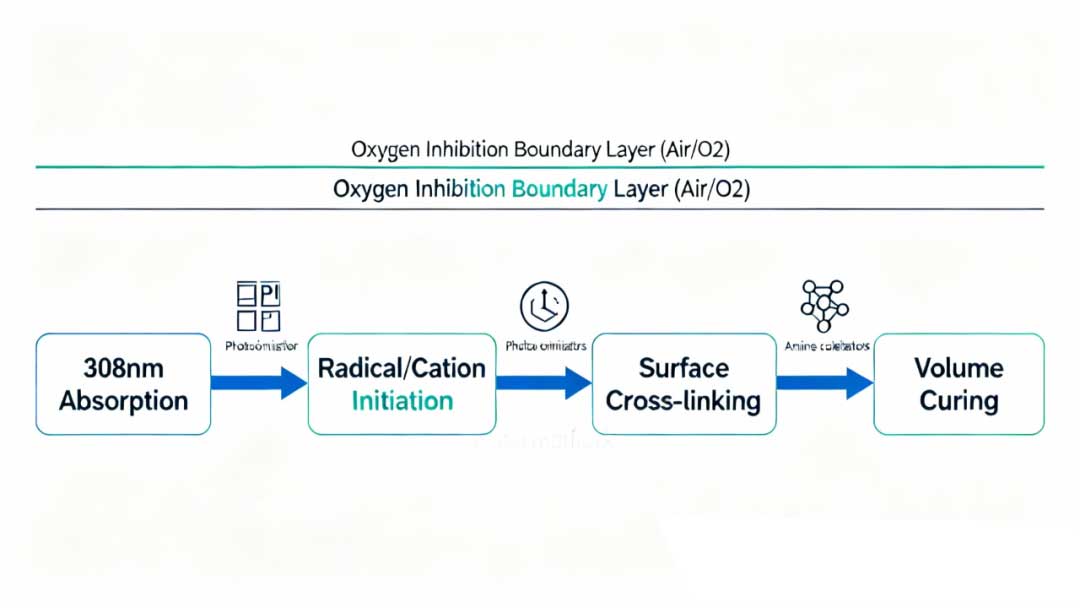
3.2 Cationic UV System (Epoxy-based) — 308 nm Sensitization Route
A. Main Component
Epoxy resin system (requires cationic initiation)
B. Initiation System
Typical salt-type cationic PI (limited direct excitation at 308 nm)
Photosensitizer: e.g., anthraquinone derivatives, absorbs 308 nm and transfers energy to PI → generates acid to initiate polymerization
C. Synergistic Additives
Appropriate amount of leveling/defoaming and weather resistance stabilizers
Process-wise, combine with step-by-step curing/mixed light arrangement to achieve volumetric crosslinking
3.3 (Extended) Example Molar Ratios for PUA Prepolymer Synthesis (from the patent scenario in your materials)
This information is for understanding variables and windows, not the final coating formulation percentages:
Polyester diol : Isocyanate : UV monomer = 1:2:2
Or 0.5:1:1.5
Or 1:2:3
Different ratios will significantly affect the final hardness/flexibility/crosslinking density/adhesion, etc., and require small-scale optimization in conjunction with the process and objectives.
IV. Production Line and Process: Turning “Curable” into “Mass-Producible”
1) Exposure and Dosage: Excimer lasers have high instantaneous light intensity, but lower total energy density than mercury lamps. Real-time calibration at 308nm using an energy meter is recommended; ensure the “hundreds of mJ/cm²” requirement is met (depending on the formula/thickness) by coordinating line speed, irradiation length, and lamp distance.
2) Light Intensity Stability and Uniformity: Monitor lamp aging/temperature drift with closed-loop control; cavity reflection and modular array ensure lateral uniformity, avoiding streaks/shadows.
3) Oxygen Inhibition Management: Prioritize nitrogen protection (air displacement on the coating surface); or use amine co-initiators + moderate reduction in line speed; for thick coatings/difficult-to-cure systems, use a multi-step strategy of “surface first, then deep layer, then surface finishing.”
4) Hybrid Curing Arrangement: A common process is “LED/low-mercury pre-curing → 308nm surface treatment → LED/mercury deep curing → (optional) 308nm secondary surface finishing,” achieving a triple balance of surface effect, low migration, and volume cross-linking.
5) Safety and HSE: 308nm is harmful to skin and eyes, requiring protective covers and interlocks; inert gas protection is mandatory in 172nm applications to avoid ozone and efficiency loss.
V. Application Landscape: A “Must-Have Solution” for High-Value Segments
1) UV Coatings
Ultra-matte wood coatings: Surface treatment with 308nm in the topcoat stage utilizes oxygen inhibition and rapid surface curing to form nano/micro-scale roughness, resulting in an ultra-matte appearance with low reflectivity and scratch resistance, already implemented in high-end flooring/furniture.
Plastic exterior parts: Low heat load, instantaneous surface curing, with fine control over hardness/feel/matte finish, suitable for consumer electronics casings and automotive interior heat-sensitive materials.
Industrial Functional Coatings: Higher crosslinking density and compactness, beneficial for anti-graffiti/corrosion protection and outdoor weather resistance (note: avoid pigments with strong absorption at 308nm in the formulation).
2) UV Inks
Low-migration food packaging: 308nm is used as a secondary irradiation step to further decompose residual initiators and unreacted double bonds, reducing odor and migration.
Inkjet varnish/lamination pretreatment: Controlled dosage creates microtextures on the varnish surface, achieving selective matte/gloss finishes or improving initial lamination adhesion.
High-opacity white ink: Bypasses the shielding of some pigments to long-wave UVA, improving near-surface curing; thick ink layers can be used with double-sided or extended irradiation.
3) UV Adhesives
Electronic packaging: Rapid positioning and curing in micro-gaps/complex structures; free radical/cationic composite systems achieve dual-channel curing at 308nm and after sensitization, resulting in dense, temperature-resistant bonds without infrared overheating.
Medical device bonding/coating: Instantaneous curing on transparent medical plastics, low migration, and regulatory compliance.
Optical adhesives: Short-wave matching initiation reduces yellowing, resulting in a transparent and pure adhesive layer, facilitating localized curing and assembly.
4) Photoresists/Optical Fiber Coatings
Large-area or low-precision panels/circuit boards: 308nm can be used as a parallel light exposure source (high-precision chips are already dominated by 248/193nm).
Optical fiber coatings: Under the demands of mercury-free and low-ozone processes, excimer lasers are being explored to achieve rapid curing and dense network construction (high-speed drawing requires extremely high light intensity, which still needs verification and improvement).
VI. Relationship with LED/Mercury Lamps: Replacement? More of a Complement
LED: Good long-wave penetration, excellent energy efficiency, suitable for main body deep curing and economical production;
Mercury lamps: Broad spectrum compatible with multiple types of initiators, but heat load/mercury content are pain points;
Excimer lasers: Unique advantages in “ultra-matte/high crosslinking/low migration/heat-sensitive materials” scenarios – the best approach is a mixed curing arrangement for optimal performance and cost.
VII. Selection and Implementation Checklist (Directly applicable to production lines)
- Target Definition: Matte level/Hardness/Chemical resistance/Migration threshold/Odor indicators → Reverse engineering of spectrum and formulation;
- Four Key Formulation Elements: Aliphatic resin + multifunctional monomer; 308nm matched PI blend; Amine co-initiator for antioxidant properties; Polymerizable/embedded components for migration control;
- Three Key Process Techniques: Nitrogen protection/Dosage calibration/Lamp distance and line speed linkage;
- Three Key Quality Control Measures: Online energy meter; Surface/volume dual-end curing confirmation; “Before and after” comparison and residue assessment.
VIII. Risks and Pitfalls
- Directly transferring LED formulations to 308nm, PI mismatch → Insufficient initiation;
- Only considering peak power without considering cumulative dose → Under-curing in the inner layer;
- Ignoring lamp aging and temperature drift → Uneven curing and streaking;
- Running thick film/high-white ink in one pass → Surface dry but inner layer uncured;
- Forcing curing without nitrogen protection against oxygen inhibition → Surface tackiness/poor wear resistance;
- Relying solely on additives for surface matting → Compromised feel/transparency, neglecting the potential of excimer “self-matting”;
- Pursuing extreme matte finish while neglecting toughness → Risk of embrittlement;
- Using aromatic PI for high efficiency → Yellowing and outdoor weather resistance issues.
IX. Prospects and Industrialization
Excimer technology is mercury-free and aligns with green regulatory trends; its feasibility has been proven in high-end applications such as wood products, consumer electronics, automotive interiors, and low-migration packaging. Equipment lifespan, output stability and cost optimization, standardized parameter guidelines, and talent training are key to scaling up. Future highlights include tunable wavelength excimer and hybrid LED/mercury light source systems, as well as scenario-based solutions for 3D parts.