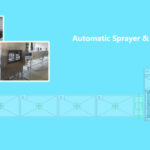
Automatic loading and unloading manipulator for UV vacuum coating is an automation equipment specifically used in plastic vacuum coating process via chain spindle conveyor system. It’s mainly used for efficiently and accurately handling the workpieces loading and unloading between vacuum coater and uv line. The core technology lies in robotic arms, conveyor and machine vision systems to automatically identify, grasp, transport and positioning. This not only reduces reliance on manual labor but also significantly improves the continuity and stability of the production process.
In coating production lines, the introduction of automated loading and unloading technology not only enhances production efficiency but also effectively improves the working environment. Automated systems can operate stably in harsh conditions, ensuring worker safety while reducing production interruptions caused by environmental factors. At the same time, automated systems can run continuously 24 hours a day, greatly increasing equipment utilization and production capacity.
Robot Technical Configuration Details
| ITEM | SPECIFICATIONS |
| Robot Main Body | Multi-axis robotic arm: 4-axis robotic device, providing flexible range of motion and precise positioning capabilities. Material: Made of high-strength steel, balancing lightweight design and corrosion resistance. |
| Drive System | Servo Motor: High-precision servo motors drive the movement of each joint, ensuring fast response and accurate positioning. Reducer: Paired with a precision harmonic reducer to enhance torque and motion stability. |
| End Handler (Fixture) | Customized Fixtures: Designed according to the shape and size of the workpiece, common types include pneumatic grippers, vacuum suction cups, or magnetic fixtures.
Quick Change Mechanism: Supports rapid fixture replacement to meet the needs of multi-variety production. |
| Sensor System | Position Sensor: Encoder or grating ruler, provides real-time feedback on the robotic arm’s position. Force Sensor: Detects gripping force to prevent damage to the workpiece. |
| Control System | PLC or Industrial PC: Acts as the main controller, coordinating the movement of the robotic arm with the coating equipment. Motion control card: Enables multi-axis synchronous control and high-precision trajectory planning. Human-Machine Interface (HMI): Provides an interface for operation, supporting parameter settings and status monitoring. |
| Safety Protection | Collision Avoidance System: Prevents the robotic arm from colliding with equipment through force feedback or visual detection. Emergency Stop Device: One-touch emergency stop function to ensure operational safety. |
Robot Features
- High-precision positioning: Uses an advanced servo control system to ensure precise positioning of workpieces during the coating process, avoiding uneven coating caused by deviations.
- Automated operation: Fully automated loading and unloading reduce manual intervention and improve production efficiency.
- Vacuum environment compatibility: The equipment is designed to meet the requirements of a vacuum environment and can operate stably in vacuum coating equipment.
- Multi-axis linkage: Usually equipped with multi-axis robotic arms to flexibly accommodate workpieces of different shapes and sizes.
- Quick changeover: Supports fast fixture changes, suitable for multi-variety, small-batch production needs.
Advantages
- Improved efficiency: Automated operation significantly shortens loading and unloading times, enhancing overall production efficiency.
- Quality assurance: Eliminates errors from manual operation, ensuring stable coating quality.
- Cost reduction: Reduces labor costs and decreases waste rate caused by operational mistakes.
- High safety: Minimizes direct human contact with vacuum equipment, reducing safety risks.
Application scenarios
- Optical coating: Coating production for optical components such as lenses and optical filters.
- Decorative coating: Surface decorative coating for items like mobile phone cases and automotive parts.
- Functional coating: Functional coatings for solar panels, semiconductor devices, and other specialized applications.
How to choose a Suitable Setup?
- Workpiece size and weight: Select a robotic arm with suitable load capacity based on the size and weight of the workpiece.
- Coating process requirements: Consider the positioning accuracy and speed requirements of the coating process.
- Production scale: For small-batch production, choose a highly flexible robotic arm; for large-batch production, focus on stability and efficiency.