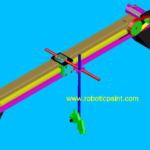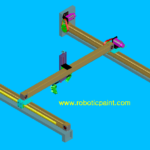
Continuous rotation spray painting machine is a popular solution which is widely accepted by our clients among all our robotic painting machines. The rotation spray device can be easily added to our multi axis painting machine for extra feasibility when developing new painting solutions.
Spray gun continuous rotation painting machine is an industrial device that achieves uniform and efficient surface spraying by enabling the workpiece or nozzle to rotate at a constant speed through a rotating mechanism. Its core principle is to use centrifugal force, pneumatics, or an electrostatic field to atomize the coating and accurately cover the target surface. It is widely used in automated coating production lines, significantly improving coating consistency, material utilization, and production efficiency.
Working Principle and Core Structure
The core of the rotary spray machine lies in the combination of ‘rotary atomization‘ and ‘automatic reciprocation‘. The equipment is usually equipped with a rotary nozzle or a rotary worktable, working in conjunction with a reciprocating machine to perform linear motion, forming a spiral or full-coverage trajectory, effectively eliminating spray dead spots and significantly improving coating uniformity.
- Centrifugal atomization: The high-speed rotating spray gun disperses the coating under centrifugal force and throws it out from the edges, forming fine atomized particles, suitable for water-based, two-component, and high-viscosity coatings.
- Pneumatic drive: Most equipment uses pneumatic high-pressure airless spraying technology, using compressed air to drive a plunger pump, achieving high-pressure (up to 25MPa) continuous spraying without the need to dilute the coating.
- 360° rotation system: The workpiece is fixed on a rotating platform, or the spray head moves in a circular motion around the workpiece, ensuring full coverage of complex surfaces (such as the inner wall of pipes, tanks, and irregular parts) without dead angles.
- Intelligent control: High-end models integrate PLC and touch screen, supporting multi-stage program programming (such as acceleration-constant speed-deceleration), synchronized control of spraying time, rotation speed, and flow, with precision up to ±5μm.
Rotation Spray Painting Machine Application Performance Data
| Paint type | Viscosity range (Coating-4 cup, s) | Rotational Speed (RPM) | Spraying Pressure (MPa) | Reciprocating speed (mm/s) | Application scenario | Key collaboration logic |
| Water base paint | 15–30 | 30,000–45,000 | 0.3–0.6 | 800–1200 | Home appliance casings, electronic components | Low viscosity allows high-speed movement, requiring medium to high rotational speeds to ensure fine atomization and avoid sagging; reciprocating speed and flow rate should increase synchronously, with film thickness controlled at 20–30μm. |
| UV/PU paint | 30–60 | 40,000–50,000 | 0.6–1.2 | 500–800 | Plastic toys, phone cases, hardware parts | Medium viscosity requires high speed, medium-pressure atomization, and a moderate reciprocating speed to ensure even coverage |
| epoxy resin | 60–120 | 25,000–35,000 | 1.5–3.0 | 300–500 | Construction machinery | For high viscosity, the reciprocating speed needs to be reduced, and the spraying pressure and rotation speed should be increased to achieve coordinated atomization. |
| Polyurethane foam material | >120 | 20,000–30,000 | 15–25 | 200–400 | Building insulation | Extremely high viscosity requires high-pressure airless drive, the rotational speed should not be too high to prevent splashing, and the reciprocating speed should be very low to ensure dense foaming. |
| Electrostatic paint/Photoresist | 5–20 | 45,000–50,000 | 0.1–0.3 | 600–1000 | Optical films, ITO glass, touch screens | Ultra-low viscosity requires extremely high rotational speed, low air pressure electrostatic assistance, and the reciprocating speed needs to be stable |
Development Trends and Technical Challenges
Intelligent Upgrading: The integration of 5G remote monitoring, AI visual coating thickness inspection, and predictive maintenance systems is gradually replacing traditional manual debugging.
Environmental Protection: Water-based coatings and high-recovery (>95%) paint mist recovery systems have become standard, complying with national VOCs emission standards.
Cost Barrier: High-end fully automated lines are still relatively expensive, customizable mid-to-low-end equipment or any economical solution to be developped.