Cyclone spray booth is an industrial spray painting equipment based on airflow dynamics and centrifugal separation principles. it’s used more and more for painting system for its cost effective and high efficient filtration performance. Comparing to traditional spray booth design, cyclone spray booth integrates a basic vortex water curtain and waste filter device which is normally installed separately outside workshop. Its core function is to achieve efficient paint mist capture and air purification through controllable swirling airflow.
Cyclone spray booth working principles
1- Air Intake and Swirl Formation
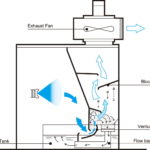
External air is forced into the top or side air intake channel of the spray booth by a fan. Under the action of guide vanes, it enters the sealed working chamber tangentially, forming a high-speed rotating vortex field. This airflow structure causes the air inside the chamber to move downwards in a spiral pattern, generating a stable centrifugal force field.
2- Paint Mist Centrifugal Separation
Paint mist particles generated during the spraying process enter the swirling zone with the airflow and move towards the chamber wall due to inertia. Because the density of paint mist particles is much greater than that of air, they impact the inner wall surface under the strong centrifugal force, adhering to the wet water film or dry filter material surface, achieving solid-liquid separation.
3- Clean Air Circulation
The clean air, after separating the paint mist, flows upwards along the central axis. After multi-stage filtration (such as primary and secondary filter cotton), it can be selectively recycled or discharged through the exhaust pipe, significantly reducing energy consumption and VOCs emissions.
4- Paint Sludge Collection and Treatment
The paint sludge adhering to the wall naturally settles under gravity and collects in the bottom sludge tank. In wet systems, the paint sludge is dissolved in circulating water and separated in a sedimentation tank; in dry systems, it is captured by replaceable filter materials and cleaned regularly.
This system does not rely on water curtains or activated carbon adsorption, has a compact structure, and is easy to maintain, making it suitable for small to medium-batch surface spraying of metal and plastic parts.
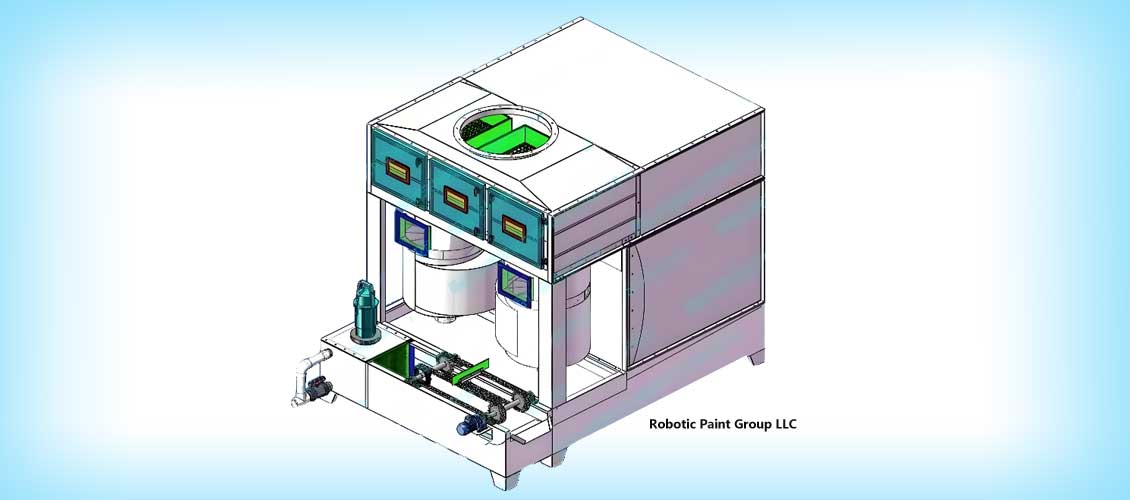
The core components of cyclone spray booth includes swirl chamber, demisting layer, spraying system and water circulation modules.
Swirl Chamber
This is the core part, where the exhaust gas rotates at high speed, and the large paint mist particles are thrown to the chamber wall by centrifugal force, then flow to the bottom water pool.
Demisting Layer
Located above the swirl chamber, hollow packing balls and demisting plates are used to further filter out residual small water droplets and particles, making the discharged air cleaner. 3. Spray System
Water mist is sprayed from the top of the tower, making full contact with the rising exhaust gas, washing down fine particles and simultaneously cooling the gas.
Water Circulation System
The water pool at the bottom collects paint sludge, and the water can be recycled. Regular cleaning is sufficient, making it relatively convenient.
The core advantage lies in its use of cyclone separation technology, achieving a paint mist capture efficiency of over 95%, significantly higher than traditional spray booths. This saves paint, reduces pollution, and meets environmental requirements. The swirling airflow design results in a more even paint layer, especially suitable for complex workpieces, reducing rework rates. Furthermore, its compact structure and ease of maintenance make it suitable for small to medium-batch production.
Any weakness?
Regardless any of mentioned spot lights, cyclone spray booth also has limitations: initial investment and operating costs (such as electricity consumption) are higher, and it requires more skilled operation, including standardized procedures and regular maintenance. For particularly large-scale spraying operations, it may need to be used together with additional equipments.
In summary, it is particularly suitable for small to medium-batch production scenarios that prioritize efficiency, environmental protection, and coating quality.