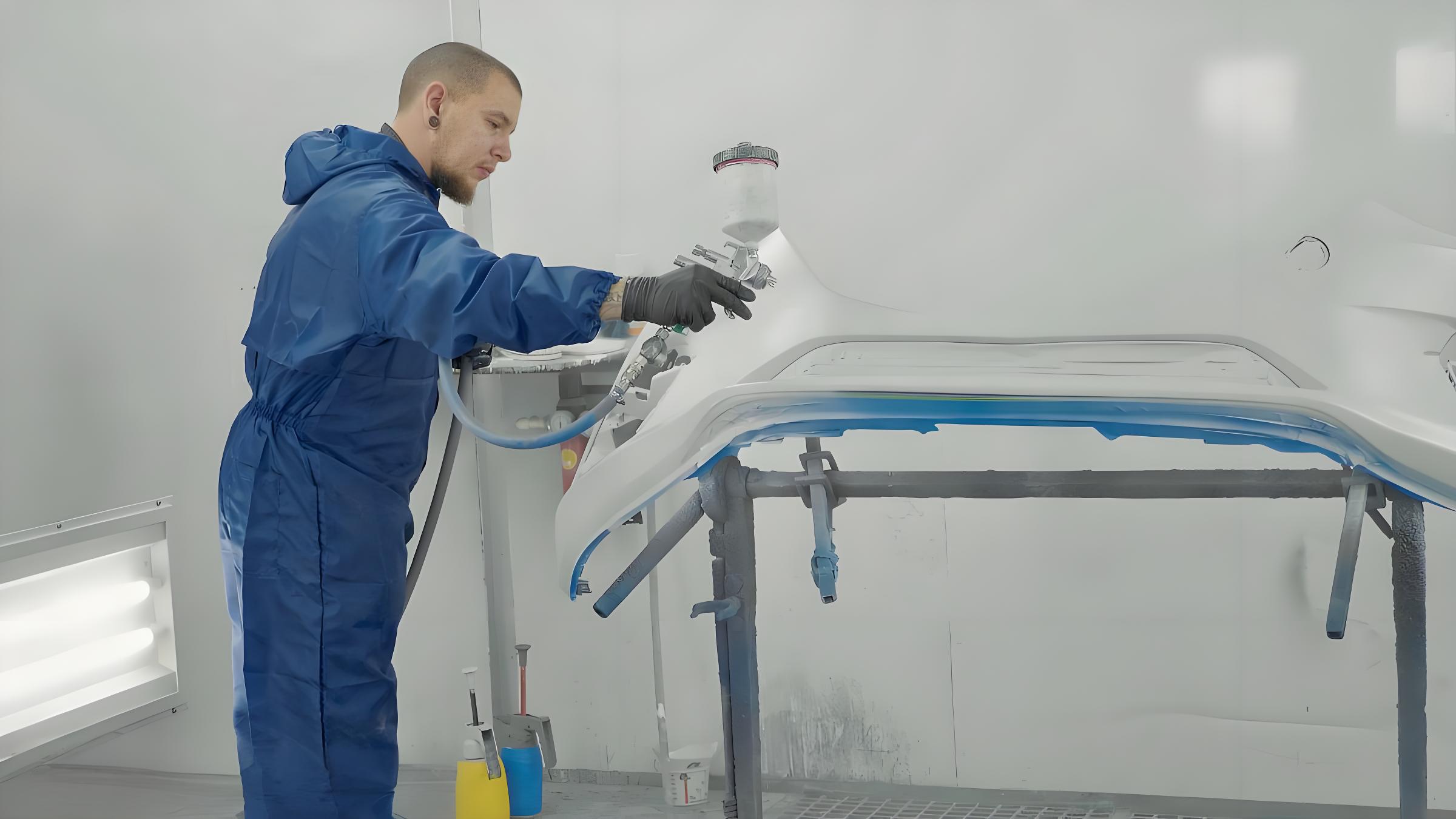
Bumper is the most important part from car exterior plastic components. In order to make all components harmonize properly after assembly, surface painting plays an crucial role from the entire production process. In following section we’ll in-depth analyze the car bumper painting process and it’s key technologies. It also works with other car exterior plastic parts painting.
Process Flow
Loading → Pretreatment (Pre-degreasing → Degreasing → Rinse 1 → Rinse 2 → DI Rinse → Blowing) → Drying → Cooling → Transfer to Painting Line → Wiping and Polishing → Flame Treatment → Electrostatic Dust Removal → Primer Spraying → Leveling → Topcoat Spraying → Leveling → Varnish Spraying → Leveling → Curing → Inspection, Polishing, and Testing → Unload
The modern process of pretreatment cleaning alredy replaced by snow blasting which be able to remove grease and impurities efficiently. It can also reduce the coating system setup costs with less space requirement.
Painting Process
Pre-treatment
Pre-treatment is the first step of bumper spraying quality control. Firstly, pre-treatment can improve the anti-corrosion performance of the coating and extend the workpiece service life. On the other hand, it can improve the coating adhesion to the substrate and make the bumper coating have uniform performance. The key processes are degreasing and flame treatment. Degreasing is to remove oil and impurities on the surface. Flame treatment is to improve the surface energy of plastic parts, enhance adhesion and durability, and remove surface impurities.
Polishing and cleaning
After pre-treatment, the bumper comes to polishing and cleaning process. This process can be saved based on the actual workpiece surface conditions, but it must be performed when the workpiece surface is uneven or has other damage.
Flame treatment
Flame treatment is the process of oxidizing the plastic surface through high-temperature (over 3000°C) gas flame. Surface tension or surface energy is generally used to measure the substrate ability to absorb liquids. If the surface energy is high, the liquid will become more wettable on its surface and have good ductility, which is the basis for the substrate to absorb liquids. Flame treatment can increase the substrate surface tension, making the contact between substrate and coating stronger and easier to spray.
Flame treatment involves a series of complex physical and chemical reactions. On the one hand, the high-temperature flame transfers energy to the grease and impurities on substrate, causing them to evaporate under heat, so it brings cleaning results. On the other hand, the flame contains a large number of ions with strong oxidizing properties. These ions react with the surface of the treated object at high temperatures to form a layer of charged polar functional groups on the surface, thereby increasing the substrate surface energy and its ability to absorb liquids.
Maintaining a certain flame temperature and distance then performing this pre-spraying treatment on the workpiece surface at an appropriate moving speed can reduce the surface stress, increase its adhesion and improve the spraying quality.
Electrostatic dust removal
It will remove burrs on workpiece surface due to electrostatic adsorption, ensure its cleanliness before spraying, and help improve the spraying yield rate. The main equipment can be an electrostatic dust removal gun, an electrostatic dust removal ion blower, an electrostatic dust removal ion stick, etc.
Primer spraying
The purpose of primer coating is to improve the anti-penetration ability of coating, enhance the protection to substrate, cover the minor defects on the substrate surface, strengthen the adhesion between the topcoat and workpiece, ensure the uniformity of topcoat color. The thickness of the primer layer is usually 10-20μm (dry film).
Topcoat spraying
Applying the topcoat is a key stage in completing the coating process. The role of the topcoat is to provide the required decorative color so that appearance meets the design requirements, and protect the workpiece from the erosion from atmosphere and acid rain, prevent ultraviolet light from penetrating, and greatly increase the substrate anti-aging ability. In multi-layer spraying, the thickest topcoat coating is usually 15-25μm.
Clearcoat
The function of clearcoat is to enhance the topcoat’s resistance to external corrosion, protect the topcoat from oxidation, and increase the metallic luster of topcoat, making the product’s appearance more vivid. The paint layer thickness is usually 30 to 50 μm.