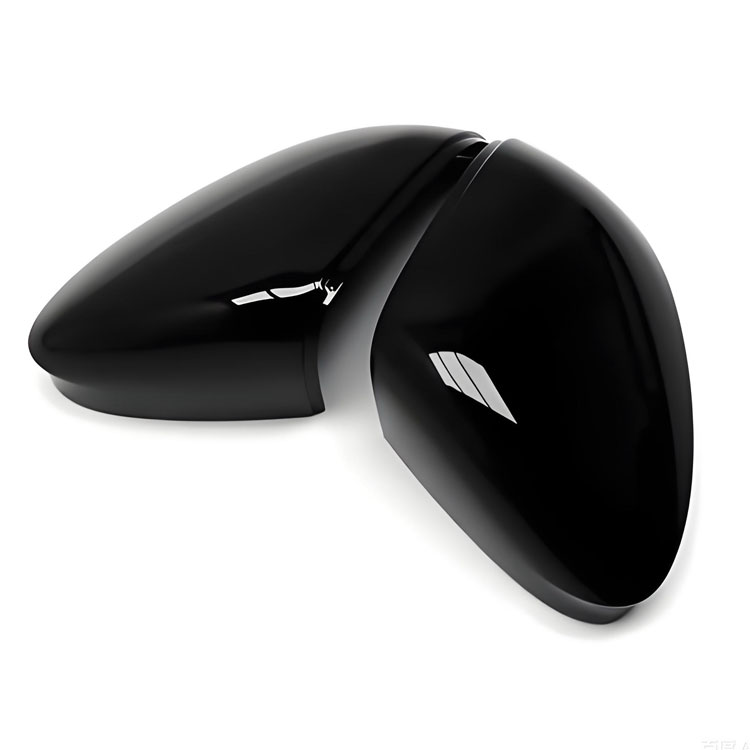
Piano black coating is a manufacturing technique that achieves a high-gloss, durable surface effect through multi-layer spraying and fine polishing processes. It is widely used in high-end products such as automotive interior parts. Its core principle lies in creating a mirror-like finish similar to piano lacquer through the superposition and processing of multiple layers. Its successful implementation depends on strict control of the environment, materials, and processes.
Environmental Conditions
- Temperature: The spraying environment temperature should be controlled between 15°C and 25°C. Within this temperature range, the paint’s viscosity and flow properties are optimal, preventing problems such as premature drying (e.g., orange peel) caused by excessively high temperatures or poor leveling caused by excessively low temperatures.
- Humidity: The relative humidity should be maintained between 50% and 70% (specific requirements may vary depending on the type of coating). High humidity may lead to paint surface fogging or reduced adhesion.
- Cleanliness: The spraying area must be a dust-free environment, and the air velocity should be ≤ 0.3 m/s to prevent dust particles from adhering. Cleanliness is usually maintained through a high-efficiency filtration system (such as a HEPA filter).
Workpiece Pre-treatment
The workpiece surface must be thoroughly clean, free of oil, mold release agents, and other impurities. Common steps include:
- Degreasing: Cleaning with an alkaline cleaning agent (pH 10-12) to remove grease.
- Water rinsing: Rinsing with RO pure water (conductivity ≤20 μS/cm) to avoid residual ions.
- Phosphating treatment: Using a zirconium-based conversion coating (film weight 0.2-0.5 g/m²) to enhance coating adhesion. For complex workpieces (such as speaker enclosures), ultrasonic cleaning may be required to remove residues from micropores.
Coatings and Spraying Parameters
Coating Selection:
- Primer: A two-component epoxy system is typically used, with a viscosity controlled at 18-22 seconds (using a Ford Cup No. 4).
- Topcoat: Piano black topcoat requires high gloss. Polyurethane colored paint (black) and high-solids clear coat (transparent layer) are commonly used, with film thicknesses controlled at 15-20 μm and 40-50 μm respectively.
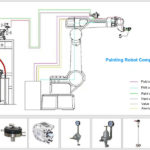
- Spraying Equipment: A spraying robot with a high-pressure air-mix spray gun (atomization pressure 0.3-0.5 MPa) is used to ensure uniform coverage of complex curved surfaces. The spray overlap rate is ≥50%, and the gun speed is 400-600 mm/s.
- Visual Positioning: A machine vision system is used to achieve a trajectory accuracy of ±0.5 mm, preventing missed areas or paint buildup.
Curing and Post-processing
- Leveling and Pre-drying: After spraying, let it stand for 10 minutes for leveling, then pre-bake at 60°C for 40 minutes to allow the primer to surface dry.
- High-temperature Curing: The topcoat needs to be cured in a constant temperature oven at 80°C for 40 minutes, and the resin cross-linking degree must reach over 90%. The oven temperature fluctuation must be controlled within ±2°C, usually using a PID temperature control system.
- Cooling and Quality Inspection: Forced cooling to below 35°C, 100% inspection using a laser film thickness gauge (accuracy ±1μm), gloss meter, etc., with automatic sorting of defective products.

Eight Control Points for Piano Black Coating
1- Environmental Parameter Management
The spraying workshop must maintain a temperature of 23±2℃ and a humidity of 55±5%RH. The spraying plant uses a PLC-linked fresh air system that automatically records environmental data every 5 minutes. Dust particle count is controlled to ISO 7 cleanroom standards (≥0.5μm particles ≤352,000/m³).
2- Dynamic Paint Viscosity Adjustment
Real-time compensation of paint viscosity is achieved through a constant temperature paint delivery system (25±0.5℃) and an automatic viscometer (rotary type, accuracy ±0.1s). Data shows that for every 1s increase in viscosity fluctuation, the orange peel value increases by 0.3-0.5.
3- Optimized Spraying Distance
The spray gun should be kept at a distance of 200-250mm from the workpiece. A distance deviation of >10mm will lead to a film thickness difference exceeding 15%.
4- Film Thickness Gradient Control
For casings with sharp edges, different spraying parameters need to be set. For example, at a 90° corner, the gun speed is reduced to 300mm/s during programming, and the paint output is increased by 20% to prevent edge exposure.
5- Curing Curve Management
A three-dimensional curing model of temperature-time-film thickness is established. When the clear coat thickness is >50μm, the curing time needs to be extended by 5 minutes to avoid bubbles or pinholes.
6- Equipment Preventive Maintenance
The color change module must be cleaned after every 5000 pieces produced, and the electrostatic generator voltage must be checked weekly (should be stable at 60-90kV). Experience shows that regular maintenance can extend nozzle life by 30%.
7- Automation Integration
It approves a single process without hand touch can greatly improve the fine rate. Especially for mass production condition, automatic machine should be considered for spraying and process handling. Less manual contact means reduced dust pollution phenomenon.
8- Personnel Operating Procedures
Technicians check film thickness data every 2 hours and wear anti-static clothing (surface resistance 1×10^6-1×10^9Ω) when entering the workshop. Any manual intervention must be subject to a two-person verification mechanism.
The Difference Between Piano Black and Glossy Black
The difference between piano black and glossy black primarily lies in their manufacturing process and visual effect.
Firstly, from a manufacturing perspective, piano black is achieved through a multi-layer painting technique, utilizing subtle differences between each layer to create a unique luster similar to that of a piano surface. This process not only makes the black deeper but also enhances its scratch resistance and corrosion resistance.
In contrast, glossy black achieves its effect by increasing the brightness of the coating. This may involve using high-gloss paint or applying a transparent high-gloss topcoat over the black paint layer to obtain higher gloss and a strong reflective effect.
Visually, piano black exhibits deeper shades of black, giving a subtle yet luxurious feel. Glossy black, on the other hand, appears brighter due to its high gloss, conveying a modern and fashionable impression.