Soft kin-feel UV coating is a special type of UV resin, which is mainly designed to simulate the touch and visual effects of human skin. It’s fingerprint resistance and remain clean for a long time, strong and durable. Furthermore, there’s no discoloration, no color difference, and resistant to sunlight. Skin-feel UV curing technology is a surface treatment process based on ultraviolet radiation curing. Through the synergistic effect of special light sources (such as excimer UV lamps or UVLED) and formulated resins, the coating can be quickly cured and the surface can be given a delicate and smooth skin-feel effect.
Here are some of the main features and applications of skin-feel UV resin:
- Touch: Skin-feel UV resin can provide a delicate, smooth and elastic feeling similar to human skin.
- Visual effect: Usually presents a matte color, low gloss, avoid strong reflections and visual fatigue.
- Functionality: Scratch-resistant, repairable, and extends the coating service life.
- Curing characteristics: UV resin is cured by ultraviolet rays for rapid curing.
Skin-feel UV resin provides a unique surface treatment solution for various products through its unique chemical composition and physical properties, especially in situations where special touch and appearance effects are required.
Skin-feel UV coating core processes and key points
Core process steps
1- Pretreatment
Ensure the substrate surface is clean, flat, free of oil and impurities, and the moisture content is ≤8%. Different materials such as metal, plastic or wood need to be treated specifically (such as polishing and static removal) to improve adhesion. If the substrate has poor contact (such as glass and metal), promoter needs to be sprayed in advance to enhance adhesion.
2- Skin-feel coating application
Coating selection : UV-curing resins containing fluorinated silicone resins (such as U-Cure 9313) or high-crosslink density polyurethane acrylates (such as U-Cure 9314) to ensure smooth touch, wear resistance and stain resistance.
Coating method : Spraying is the main method, uniform coverage is required to avoid missing coating or accumulation. Each layer needs to be pre-cured when multi-layer coating is applied.
3- Anaerobic environment control (key)
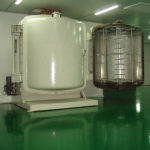
Excimer curing needs to be carried out in an anaerobic environment, and oxygen interference is eliminated by sealing the cavity + deoxidizer to achieve ultra-matte and gloss stability.
4- UV curing process
Light source selection
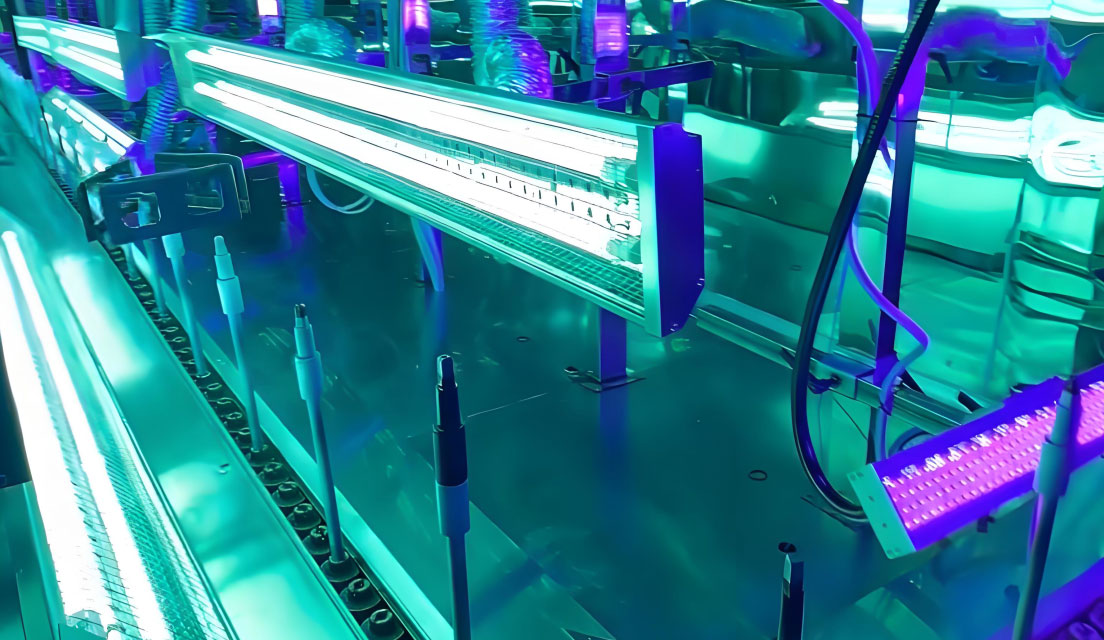
Excimer light source: 172nm or 254nm wavelength to achieve deep curing and extreme skin-feeling effect
UV LED light source: energy-saving and low temperature (to avoid thermal deformation of the substrate), uniform and controllable light intensity.
Curing parameters
Distance: usually 5–15mm (ink ≤5mm, ordinary coating 10–15mm)
Energy: adjust the irradiation intensity and time according to the coating thickness to ensure sufficient cross-linking
Performance Control
- Curing depth: according to coating thickness, light source energy and curing speed, too thick or too fast can easily lead to insufficient curing.
- Spectral matching: the light wavelength source needs to match the absorption band of the coating photoinitiator, otherwise the curing efficiency will be reduced.
- Temperature control: UV LED has significant advantages in low temperature, avoiding deformation of the coating/substrate caused by high temperature
Note: In actual production, it is necessary to select UV LED or excimer curing equipment according to the substrate characteristics (such as thermal sensitivity), and monitor the effective radiation energy through a spectrometer to optimize the process parameters
Weakness & Limitatation
Although skin-feel UV curing technology has the advantages of high efficiency, environmental protection and delicate touch, it still has the following core weakness and limitations:
High cost equipment investment: Excimer UV equipment needs to be equipped with an oxygen-free sealing system (nitrogen replacement/deoxidizer), and the equipment complexity and maintenance cost are significantly higher than traditional processes.
High cost material: Special UV coating raw materials such as fluorinated silicone resin are expensive, and the curing process requires high-purity inert gas protection
Generally speaking, the core advantage of soft feel UV coating is its high production efficiency for mass production. It’s a high end deployment. Considerring its investment, it’s not a MUST when we apply finishing on some products like furniture or consumerble items. Most of the time we have alternative choice like PET or PU resin which has big cost advantages on both machine and material.