
Paint pump is a crucial device for any type spray painting system. When goes for an automatic paint machine setup, we mostly will select peneumatic diaphragm paint pump for its affordable and high performance over decades development. Though it’s widely available to use, it’s always necessary to understand it’s principle and how we can properly configure a paint pump for problem free opertion.
How does a diaphragm paint pump work?
A diaphragm pump works by using a flexible diaphragm that moves back and forth to change the volume of a chamber, which forces fluid to move. On the “upstroke,” the diaphragm creates a vacuum that pulls fluid into the pump chamber through a suction valve. On the “downstroke,” it pushes the fluid out through a discharge valve. This action is typically powered by compressed air that alternates between the two sides of the pump, causing the diaphragms to move in unison.
Following is a diaphragm paint pump typical configuration diagram
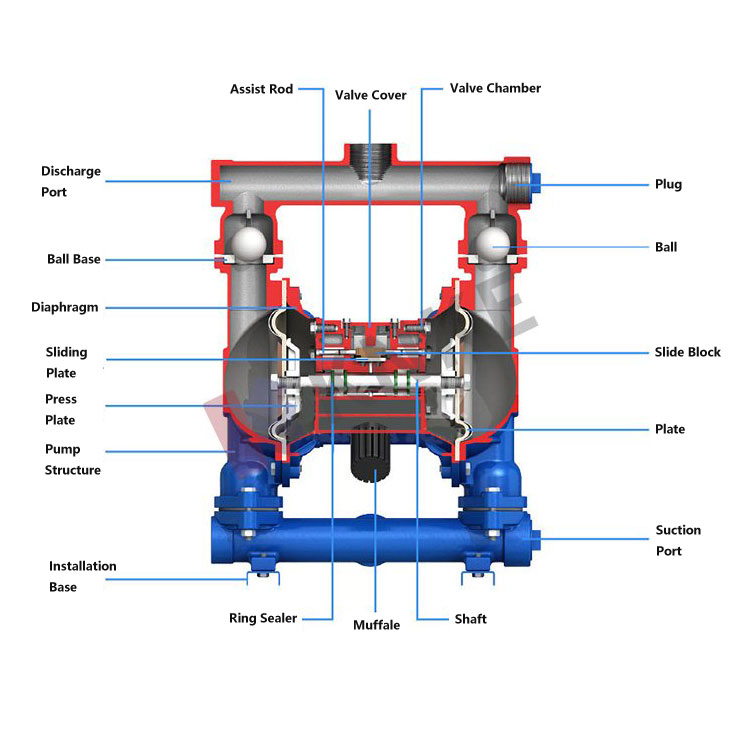
There are two diaphragms connected by a shaft. As one diaphragm is on its suction stroke, the other is on its discharge stroke, allowing for a continuous pumping action. Compressed air is directed to alternate between the two sides of the diaphragms via an air valve, ensuring this reciprocal motion. See this page about paint pump selection.
The actual product is structured as following
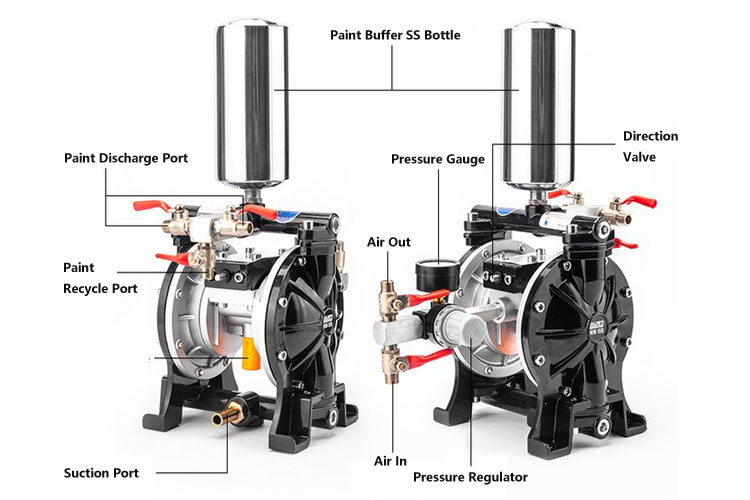
As we see, there’s an extra bottle for paint buffering during actual operation. This bottle ensures there will be sufficient paint supply instead of pumping directly from a drum to spray gun. There’s also a valve to control fluid direction and ensure the two diaphragm plates are working in correct way. As air-operated models can be noisy, a muffler is always attached to reduce noise in production environments.
What else required for production model?
In order to support continuous automatic spray painting work, we need to attach a few more components so it will work nicely. Generally we need the following:
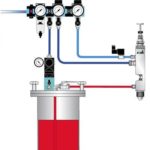
Air filter – This unit is always needed to ensure the injected air is clean enough to avoid moisture or grease in liquid. It’s normally installed at the air inlet port on diaphragm pump. Theres also a valve to adjust incoming air pressure and maintain a safe operation.
Pressure stabilizer – A smart device to maintain a stable liquid pressure so the pumping to spray gun will be always stable instead of pulsing or intermittent. This part has to be installed at the diaphragm pump disharge port. It provides a regulator and gauge for liquid pressure adjusting.
Agitator and paint tank – In most cases we will need this since we always need to mix paint pigment with a thinner. Expecially for water base paint, it has to be continuously mixed to maintain a fine component.
In order to attache above components properly to a diaphragm paint pump, we need to use a two-way or maybe three-way connector on those mentioned ports. It has to be steadily fixed to avoid any air/liquid leakage.
Diaphragm paint pump maintenance
Paint pump must be completely clean up every day after operation and make sure there’s no pigment inside piping system. Check valves are susceptible to clogging from particulates, which can impede performance. Regular maintenance of diaphragms and check valves is necessary to ensure optimal performance and prevent leakage