Adhesive spray machinery is no big difference than those well known solutions in spray painting industry. But it does have its stand alone features which will be explained in following chapter. Also, due to the various properties of different adhesive products, we will encounter a variety of issues and we will give trouble shooting solutions and suggestions of improvement.
Adhesive Spraying Main System
According to adhesive viscocity, there’re following popular choice of spraying machinery:
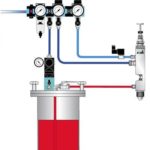
**Air-Powered Spraying Equipment:** Compressed air atomizes the adhesive (pressure 0.3-3.5MPa), suitable for low-viscosity adhesives (such as water-based adhesives).
**Airless Spraying Equipment:** High-pressure pump directly atomizes the adhesive (pressure 0.4-0.6MPa), suitable for high-viscosity adhesives (such as epoxy resins).
**Electrostatic Spraying Equipment:** An additional electrostatic field causes the adhesive to become charged and attract it (adhesive utilization rate reaches 80-90%), suitable for precision electronic packaging.
Auxiliary Devices
Constant Temperature Adhesive Supply System: Adhesive storage tank with heating function (temperature control 23-25℃±1℃), avoiding low-temperature tackification.
Automatic dilution unit: Integrated solvent metering pump (dilution accuracy ±0.5%) to handle viscosity fluctuations.
Filtration device: 5-50μm precision filter to prevent adhesive particles from clogging the nozzle.
Key Technique Features
| Techniqque | Features | Viscosity relation |
| Atomization control | The uniformity of the coating is affected by adjusting the fineness of the atomized particles (20-100μm) using air pressure/hydraulic pressure. | High-viscosity adhesives require higher pressure (e.g., airless spraying ≥ 0.5 MPa). |
| Dynamic viscosity compensation | Real-time monitoring of adhesive viscosity → automatic adjustment of temperature or dilution ratio (industrial-grade equipment function) | For every 10°C increase in temperature, viscosity decreases by 30-50%; solvent addition ≤15%. |
| Multi-stage nozzle design | Replaceable nozzles (0.2-2mm orifice diameter) to adapt to different adhesive dot requirements. | For high-viscosity adhesives, use a large-diameter nozzle (≥1mm) to prevent clogging. |
| Closed-loop feedback system | Integrated flow sensor and PLC control ensure stable glue dispensing (error < ±3%). | Compensating for flow deviations caused by viscosity variations |
| Electrostatic adsorption technology | Applying a voltage of 30-90kV causes the adhesive droplets to be directed toward the workpiece. | Reduce overspray to lower the risk of sagging in high-viscosity adhesives. |
Adhesive-Equipment Matching Rules
Low-viscosity adhesives (<500cP): Air spraying is preferred, with an air pressure of 0.3-0.8MPa (e.g., water-based latex).
High-viscosity adhesives (>5000cP): Airless/electrostatic spraying is mandatory, with a pressure ≥0.5MPa (e.g., epoxy adhesives require heating to 40℃).
Sensitive Materials: For low-temperature workpieces such as plastics, reduce spraying pressure to prevent stress deformation.
Defect Prevention Technologies
Sagging Control: Increase viscosity to a critical value (e.g., add 0.3% fumed silica thickener) + reduce single-coat thickness.
Orange Peel Removal: Optimize atomization pressure (excessive pressure leads to bubbles) and maintain ambient humidity at 40-60%.
Technology Improvement Directions
Intelligent Integration: AI vision system detects coating thickness in real time and adjusts spraying parameters accordingly (e.g., Mercedes-Benz production line application). Green Process: Water-based adhesives replace solvent-based adhesives + VOCs recovery device (meets GB 37824-2019 emission standards).
Ultra-precision spraying: Piezoelectric micro-droplet jet valve (minimum dispensing diameter 0.1mm), used for Micro LED encapsulation.
Through precise equipment selection and dynamic viscosity control, the yield rate can be increased from 70% to 95%+ (automotive industry case data).
In the adhesive spraying process, common problems are often caused by parameter mismatch, equipment malfunction or environmental factors. Based on the characteristics of the adhesive, spraying equipment, and key points of process control, the following is a systematic problem analysis and solutions:
Adhesive Painting Problems and Solutions
Sagging (Adhesive Drooping)
Causes:
- Adhesive viscosity too low (<200cP) or excessive dilution
- Spraying too thick (single layer >0.5mm) or spraying distance <20cm
- Ambient temperature too high (>30℃), accelerating flowability
Solutions:
✅ Viscosity Control:
- Add thickener (e.g., 0.3% fumed silica) or reduce thinner (total ≤15%)
- Switch to a high thixotropic adhesive (e.g., shear-thickening epoxy)
✅ Process Optimization:
- Increase spraying distance to 25-30cm, use multi-layer thin spraying (each layer ≤0.2mm)
- Lower ambient temperature to 23±2℃, or use a fast-curing adhesive (e.g., UV adhesive)
Orange Peel (Uneven Surface)
Causes:
- Excessively high atomization pressure (airborne spraying > 0.8MPa) produces bubbles.
- Uneven glue viscosity or excessively rapid solvent evaporation.
- Insufficient ambient humidity (<30%)
Solutions:
✅ Equipment Adjustment:
- Reduce atomization pressure to 0.3-0.6MPa, use a fan-shaped nozzle for even glue application.
- Add a constant temperature glue supply system (temperature control 25℃±1℃).
✅ Environmental Control:
Maintain humidity 40-60%, add slow-drying solvents (such as ethylene glycol ether) to delay evaporation.
Glue Mist (Spraying Scattering)
Causes:
- Excessively high electrostatic spraying voltage (>90kV) or excessive spray distance.
- Excessive airless spraying pressure setting (>0.6MPa).
Solutions:
✅ Technical Upgrade:
- Closed-loop electrostatic control system (dynamic voltage adjustment 30-60kV)
- Negative pressure mist extraction device to recover excess adhesive particles
✅ Parameter Correction:
Airless spraying pressure reduced to 0.4-0.5MPa, spray distance fixed at 25cm.
Bubble/Pinhole
Causes:
- Adhesive contains volatile solvents (e.g., acetone) and curing temperature rises sharply.
- Substrate surface has moisture or oil (common on metal workpieces).
Solutions:
✅ Process Improvement:
- Baking the substrate before spraying (80℃×30min) to remove moisture.
- Step-by-step curing: Pre-curing at 60℃ for 10min, then increasing to 120℃.
✅ Material Replacement:
Using solvent-free adhesive (e.g., 100% solids polyurethane).
Insufficient Adhesion
Causes:
Substrate not cleaned (residual release agent/oxidation layer) Incomplete adhesive curing (insufficient temperature/time)
Solutions:
✅ Surface Treatment:
- Plastic parts: Plasma treatment (50W, 120s)
- Metal parts: Sandblasting (Sa2.5 grade)
✅ Curing Enhancement:
- Extend curing time to 1.5 times the standard (e.g., 30min → 45min)
- Add silane coupling agent (0.5-1%) to improve interfacial bonding
Maintenance Guidelines
| Target | Guideline | Frequency |
| Nozzle anti-clogging | Rinse the nozzle daily for 30 seconds with a dedicated solvent (such as acetone). | Daily |
| Path clean | Disassemble the glue supply line monthly and perform ultrasonic cleaning (40kHz). | Monthly |
| Electrostatic generator calibration | Detect output voltage deviation (must be < ±5%) | Quarterly |
| Replace filter | Replace the 5μm filter element when the pressure difference is >0.2MPa. | Real-time monitoring |