Piano Black Coating Application Guidance

Piano Black Coating Application Guidance

Tutorial
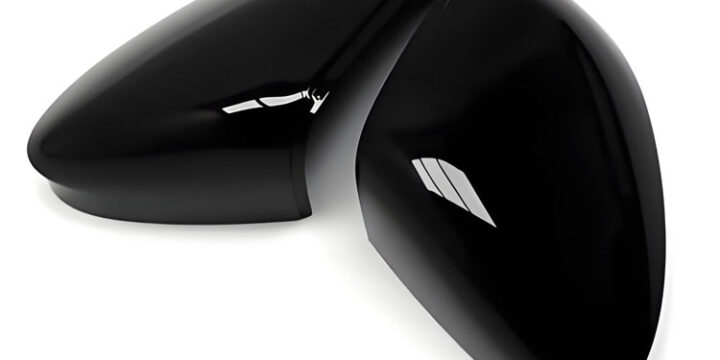
Piano black coating is a manufacturing technique that achieves a high-gloss, durable surface effect through multi-layer spraying and fine polishing processes. It is widely used in high-end products such as automotive interior parts. Its core principle lies in creating a mirror-like finish similar to piano lacquer through the superposition and processing of multiple layers. Its successful implementation depends on strict control of the environment, materials, and processes. Environmental Conditions Temperature: The spraying environment temperature should be controlled between 15°C and 25°C. Within this temperature range, the paint's viscosity and flow properties are optimal, preventing problems such as premature drying (e.g., orange peel) caused by excessively high temperatures or poor leveling caused by excessively low temperatures. Humidity: The relative humidity should be maintained between 50% and 70% (specific requirements may vary…
Read More
Adhesive Spraying Technique and Improvement Solutions

Adhesive Spraying Technique and Improvement Solutions

Tutorial
Adhesive spray machinery is no big difference than those well known solutions in spray painting industry. But it does have its stand alone features which will be explained in following chapter. Also, due to the various properties of different adhesive products, we will encounter a variety of issues and we will give trouble shooting solutions and suggestions of improvement. Adhesive Spraying Main System According to adhesive viscocity, there're following popular choice of spraying machinery: **Air-Powered Spraying Equipment:** Compressed air atomizes the adhesive (pressure 0.3-3.5MPa), suitable for low-viscosity adhesives (such as water-based adhesives). **Airless Spraying Equipment:** High-pressure pump directly atomizes the adhesive (pressure 0.4-0.6MPa), suitable for high-viscosity adhesives (such as epoxy resins). **Electrostatic Spraying Equipment:** An additional electrostatic field causes the adhesive to become charged and attract it (adhesive utilization rate…
Read More
Diaphragm Paint Pump Indepth Explained

Diaphragm Paint Pump Indepth Explained

Tutorial
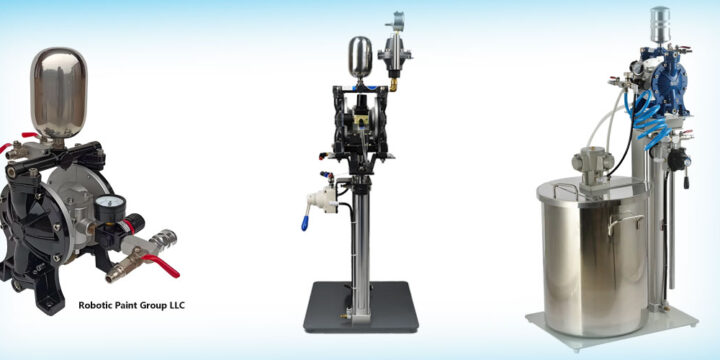
Paint pump is a crucial device for any type spray painting system. When goes for an automatic paint machine setup, we mostly will select peneumatic diaphragm paint pump for its affordable and high performance over decades development. Though it's widely available to use, it's always necessary to understand it's principle and how we can properly configure a paint pump for problem free opertion. How does a diaphragm paint pump work? A diaphragm pump works by using a flexible diaphragm that moves back and forth to change the volume of a chamber, which forces fluid to move. On the "upstroke," the diaphragm creates a vacuum that pulls fluid into the pump chamber through a suction valve. On the "downstroke," it pushes the fluid out through a discharge valve. This action is…
Read More
Spray Gun Caliber Size Selection Manual

Spray Gun Caliber Size Selection Manual

Tutorial
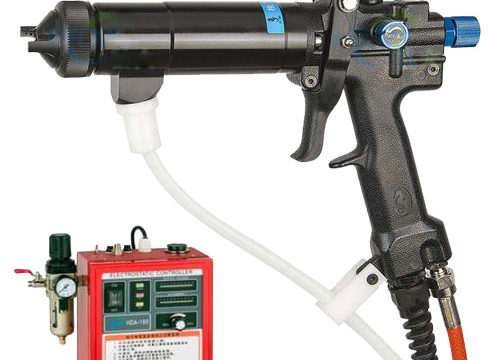
As the saying goes, "If you want to do your job well, you must first sharpen your tools." Choosing the right spray gun caliber is crucial to achieving the best spray results. So, what factors influence the choice of spray gun caliber? Relationship between Caliber and Spray Results The spray gun caliber directly affects the fineness and coverage of the spray. Generally speaking, smaller calibers produce a finer spray atomization, making it suitable for delicate applications; larger calibers provide wider coverage, making them suitable for large-scale spraying. Common calibers include 1.3mm, 1.5mm, and 1.8mm. The choice of spray gun caliber should be adjusted based on the paint type, spray area, and application requirements. The following are general guidelines: Paint Type and Viscosity In addition to caliber, the paint type and…
Read More

Indepth Understanding of Color Difference Parameters

Tutorial
Color difference is a popular issue in spray painting industry and there're numorous guides how to avoid it. But in actual operation, especially as a paint technician we must know more about the logic and understand techically how to control color difference properly using a formula or device. Let's take the most commonly used ΔE*ab as an example. ΔE*ab is the color difference formula for the Lab color space, established by the CIE (International Commission on Illumination) in 1976. The ΔE formula is as follows: ΔE = √(ΔL² + Δa² + Δb² ) Color can be represented by the three color axes: L, a, and b. When comparing a standard color and a sample color, the differences in L, a, and b values ​​are ΔL, Δa, and Δb, respectively. However,…
Read More

Flame Treatment or Annealing Before Plastic Painting

Tutorial
In order to receive the needed surface finishing, plastic products need various pretreatment including cleaning, heating and blasting etc. Flame treatment is a popular solution in many plastic painting lines. However it's not the solely choice according to the exact plastic components. In this article we'll briefly introduce the pros and cons of flame treatment and another solution called annealing. What is Flame Treatment? Flame treatment is a surface treatment technique performed on plastics before painting. It uses flame to briefly heat the plastic surface at high temperatures to improve wettability and adhesion. This treatment effectively removes oil, release agents, and other impurities from the plastic surface, while also increasing the surface's polarity, thereby improving paint adhesion. Principles of Flame Treatment Flame treatment uses a high-temperature flame to transfer energy…
Read More
How to Calculate Spray Booth Waste Air Treatment Volume

How to Calculate Spray Booth Waste Air Treatment Volume

Tutorial
Spray painting will result in a huge volume of hazards gas, especially for automated painting lines and paint curing furnace which are characterized by high air volume and low concentration. The odor of spray paint contains VOCs such as benzene, toluene, and xylene, which have a significant impact on the surrounding environment. Air volume calculation is a crucial point when programming a gas treatment solution. In actual condition there's a few calculations in order to get the volume Basic Method of Waste Air Volume Calculation Air Volume = Booth Volume (Length x Width x Height) x Air Change Frequency (60-100). The air change frequency 60-100 in the formula is an empirical value. If the spray booth operation time is short and the amount of paint sprayed is small, the value…
Read More
Putty Application Process in Surface Coating

Putty Application Process in Surface Coating

Tutorial
Putty is a popular solution in many products surface coating technologies. Especially for automotive and carbon fiber products like bumper, helmet & related parts. In order to properly apply putty, there's strict process to follow and checkup. Following we will share a sample of the putty process used in automotive parts coating and also trouble-shooting of common problems. Surface Requirements for Putty The primer on the workpiece to be applied must be completely dry and free of oil, dust, and other contaminants. If the primer is not completely dry, the solvent in the primer will not be able to evaporate after the putty is applied and cured, becoming trapped beneath the putty layer. This can easily cause bubbles and delamination when exposed to high temperatures. Mixing and Applying Putty Putty:…
Read More
In-depth Analysis of Car Bumper Spray Painting Process

In-depth Analysis of Car Bumper Spray Painting Process

Tutorial
Bumper is the most important part from car exterior plastic components. In order to make all components harmonize properly after assembly, surface painting plays an crucial role from the entire production process. In following section we'll in-depth analyze the car bumper painting process and it's key technologies. It also works with other car exterior plastic parts painting. Process Flow Loading → Pretreatment (Pre-degreasing → Degreasing → Rinse 1 → Rinse 2 → DI Rinse → Blowing) → Drying → Cooling → Transfer to Painting Line → Wiping and Polishing → Flame Treatment → Electrostatic Dust Removal → Primer Spraying → Leveling → Topcoat Spraying → Leveling → Varnish Spraying → Leveling → Curing → Inspection, Polishing, and Testing → Unload The modern process of pretreatment cleaning alredy replaced by snow…
Read More
In-depth analysis of high temperature & humidity impact for coating application

In-depth analysis of high temperature & humidity impact for coating application

Tutorial
In order to get high quality surface finishing, we always trying to seek for the best equipment as well as its most compatible coatings. Especially for cosmetic and automotive industry, the paint shop is constructed by the most advanced technologies with a variety of intelligent devices. Among all the construction reviews, environment control is the most crucial topic and it will determine if we can receive expected fine rate directly. Environment control is all about temperature and humidity as well as the air cleanness inside workshop. Following we'll deeply analyze the impact of high temperature and high humidity for coating application. Impact of high temperature on coating Different paints have different lifespans, and their lifespan shortens as the temperature rises. The viscosity of two-component paints decreases with increasing temperature. As…
Read More